
Data Center
Humidity control for uptime and reliability
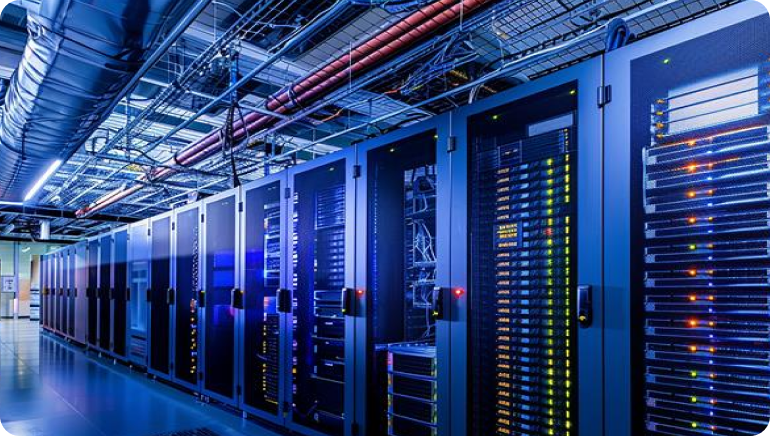
Why is humidity important for data centers and server rooms?
Humidification is required in data centers and server rooms to prevent electrostatic discharge (ESD) damaging servers. Operation of the servers does create heat, which participates to surrounding air drying.
What is ESD?
Electrostatic discharge (ESD) is the release of static electricity when two objects come into contact. Familiar examples of ESD include the shock we receive when we walk across a carpet and touch a metal doorknob and the static electricity we feel after drying clothes in a clothes dryer. A more extreme example of ESD is a lightning bolt. While most ESD events are harmless, it can be an expensive problem for your data center or server room.
Recommended humidity level for your data center or server room

- The recommended humidity level for Data center and a server room is between 30 and 60%RH.
- Allowable Humidity levels for Class 1 and 2 is between 20 and 80%RH.
How can you bring humidity to your data center or server room?
- The preferred humidification solution for Data center is evaporative humidifier and cooler. This humidification solution is able to satisfy very high capacity and will provide free cooling while humidifying.
- Atomizing humidifier should be installed with caution. Their used have caused corrosion problems on electronic circuit boards and connectors in some sites,
- For server rooms, the humidification capacity can sometimes be very small so other technology can be considered, such as ultrasonic humidifier.

How can you bring humidity to your data center or server room?
- The preferred humidification solution for Data center is evaporative humidifier and cooler. This humidification solution is able to satisfy very high capacity and will provide free cooling while humidifying.
- Atomizing humidifier should be installed with caution. Their used have caused corrosion problems on electronic circuit boards and connectors in some sites,
- For server rooms, the humidification capacity can sometimes be very small so other technology can be considered, such as ultrasonic humidifier.
Key Benefits
- Maintains 30-60% RH to prevent electrostatic discharge damage to servers from dry air caused by heat generation.
- Evaporative humidifiers like AEM use server heat for humidification while providing energy-saving cooling.
- AEM evaporative solutions meet large-scale data center humidity needs without added thermal load.
- Avoids isothermal humidifiers' extra energy use; leverages compressed air/water (ACA) for cooling-focused applications.
- Ultrasonic for small server rooms; caution with atomizing to prevent corrosion on electronics.
AEM evaporative humidifier and cooler
- AEM Evaporative humidifier & air cooler will humidified air in winter and reduce cooling demand in summer.
- AEM can also be used a indirect cooler with heat recovery heat exchanger.
- Very low energy consumption, less than 100W.
- Unique & innovative pulse to demand control with no water loss.
- Very safe & hygienic . Zero risk of stagnant water or bacteria growth.
- No need for pure water, wasting tap water.
- Evaporation efficiency up to 99% (at 200 FPM).
- Very low pressure drop across evaporation media.
- GREENGUARD Gold Certified by UL – no Volatile Organic Coumpond (VOC) in supply air
- Inorganic ceramic evaporative media material.
- Best choice for Data center aiming for PUE close to 1.
ACA compressed Air & Water
- ACA atomizing humidifier / cooler does include atomizer for installation into duct or directly in space, an electronic controller able to control up to 2 zones/spaces, RH% and temperature transmitter, and if required low pressure RO (Reverse Osmosis) water pre-treatment.
- This atomizer producing a dry fog of micro droplets (2 to 4µm) is the ideal humidification solution for cold storage as droplets are not freezing up even at very low temperature such as 32°F [0°C].
- The cooling effect of adiabatic process using heat transfer from surrounding air is making the ACA a perfect solution for Data centers or pre-cooling of gas turbine or HVAC dry coolers.